Forecasting · 2025–2026
Forecasting the Effective Federal Funds Rate
Can Ridge or Random Forest beat a repeat-last-month forecast on an untouched future test period?
Forecasting · 2025–2026
Can Ridge or Random Forest beat a repeat-last-month forecast on an untouched future test period?
Repeating the previous month’s rate was the benchmark because it is simple, transparent, and available at prediction time. Any model improvement had to survive a later, untouched test period.
Ridge reached 0.1606 RMSE versus 0.1922 for the baseline. Random Forest was worse at 0.2368. The improvement was meaningful on RMSE, while the gain on MAE was much smaller.
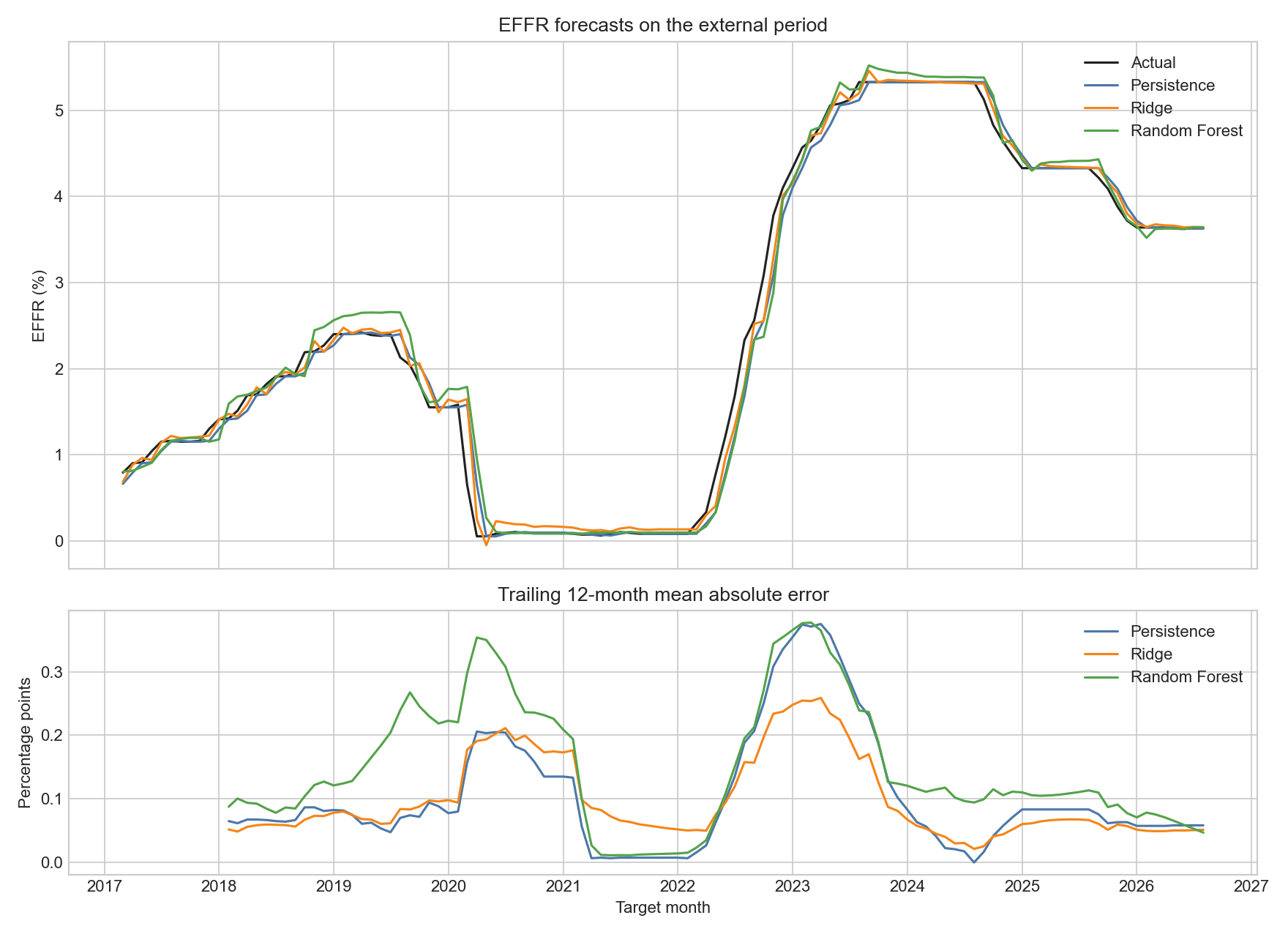
Ridge beat the baseline after I threw out the flawed first result and rebuilt the pipeline. The reported gain comes from the locked, leakage-free test—not the earlier experiment.